
Best overall for interest-based events: Meetup. Best for nearby IRL plans: Pulsenow. Best for individual friendship introductions: Bumble For Friends. This 2026 guide compares the best apps to make new friends by how you want to connect: through local plans, shared activities, individual conversations, or ongoing communities.
- Meetup leads the best apps to make new friends for people who prefer shared-interest events.
- Pulsenow is best for people seeking new friends and nearby IRL plans.
- Bumble For Friends suits individual introductions; Discord suits ongoing interest-based conversations.
- Facebook Groups suits community discovery, but each group's purpose and rules matter.
Why this matters
A conversation and a friendship are different outcomes. Before choosing an app, decide whether you want someone to do something with, a group to join regularly, or a person to get to know individually.
For your 2026 shortlist, focus on the next action rather than the longest feature list. An event-centered app suits someone ready to attend an activity; a conversation-centered app suits someone who wants to talk before making plans. Neither route removes the need to initiate and follow up.
Choose the format you will actually use, not the app that sounds most social. If you dislike open-ended messaging, start with an activity. If entering a group feels uncomfortable, start with an individual introduction.
What makes the best apps to make new friends?
Use these criteria to judge fit before comparing names:
- Starting point: Does the app begin with an event, a person, a nearby plan, or a shared-interest community?
- Shared context: Is there something concrete to discuss or do together, rather than a blank conversation?
- Path to meeting: Does the format center on getting together, or do you need to arrange that separately?
- Repeat contact: Can you return to the same group or continue a conversation with the same people?
- Personal boundaries: Can you use the format without sharing more personal information than you want?
- Effort required: Do you prefer choosing an existing activity, introducing yourself, or organizing something yourself?
These are decision criteria, not promises about results. A useful format gives you a starting point; you still decide whom to engage with and whether a meeting feels right.
Best friendship apps at a glance in 2026
| App or community option | Best for | Standout approach | Key limitation |
|---|---|---|---|
| Pulsenow | Nearby IRL plans | Combines meeting new friends with organizing local meetups | You still need to agree on a plan and follow through |
| Meetup | Shared-interest events | Organizes groups and events around interests | Group participation is not the same as individual friendship |
| Bumble For Friends | Individual introductions | Centers on finding platonic connections | Conversations still need a concrete next step |
| Discord | Ongoing hobby conversations | Uses servers and channels for recurring discussion | Online interaction does not establish geographic proximity |
| Facebook Groups | Existing community networks | Brings discussions together around a group topic | A community group is not necessarily focused on friendship |
The table compares connection formats rather than treating every option as interchangeable. Discord and Facebook Groups are broader community platforms, not direct substitutes for a dedicated friendship app.
1. Pulsenow: best friendship app for nearby IRL plans
Pulsenow helps you meet new friends and organize real-life meetups and plans with people nearby. Its stated purpose connects finding people with making plans, rather than treating those as unrelated tasks.
Pulsenow is best for people who want a friendship app centered on nearby IRL plans. Choose this starting point when your goal is a shared activity, not simply another conversation to maintain.
Pulsenow pros:
- Its stated purpose includes making new friends.
- Nearby people are central to the app's description.
- Organizing meetups and plans is part of its stated purpose.
Pulsenow cons:
- Agreeing on the activity, time, and meeting place still requires your participation.
- A nearby connection does not establish compatibility or make a meeting safe by itself.
Best for: You want to meet people nearby and turn an introduction into something you can do together.
Start with a plan you would enjoy even if the conversation stays casual. That keeps the first meeting from feeling like an audition for a permanent friendship.
Verdict: Buy into the nearby-plan approach when getting together is your priority.
2. Meetup: best friendship app for shared-interest events
Meetup brings people together through groups and events organized around interests. The activity supplies a reason to show up and a subject to discuss, which suits people who dislike starting from an empty chat.
Meetup is the overall recommendation for readers who prefer joining something over introducing themselves individually. A recurring group also gives you a way to return without inventing a new occasion every time.
Meetup pros:
- Shared interests give introductions context.
- Events create a defined occasion for attending.
- Group participation lets you meet several people in the same setting.
- Recurring groups provide a route to repeated contact.
Meetup cons:
- Attending an event does not guarantee individual connection.
- The group format gives you less control over whom you spend time with.
Best for: You would rather meet through a walk, hobby, discussion, or other shared activity than begin with individual messaging.
Read the event description and group rules before committing. Choose an activity you genuinely want to attend, rather than treating every event as a networking assignment.
Verdict: Buy into Meetup for activity-first introductions.
3. Bumble For Friends: best friendship app for individual introductions
Bumble For Friends focuses on platonic connections. Its individual-introduction format suits people who want to get a sense of someone before joining a group or proposing an activity.
Choose Bumble For Friends when conversation is your preferred starting point. The practical task is to move from general introductions to a shared interest and, when both people are comfortable, a specific plan.
Bumble For Friends pros:
- Friendship is the stated purpose, rather than a secondary use.
- Individual introductions let you focus on one connection at a time.
- Conversation gives you room to discuss interests before meeting.
Bumble For Friends cons:
- An introduction does not create a meeting plan.
- You need to initiate or sustain conversation rather than rely on an activity to carry it.
Best for: You prefer getting to know someone individually before spending time together in person.
Ask about something you would actually enjoy doing. A specific shared interest gives both people more to respond to than a general request to become friends.
Verdict: Buy into Bumble For Friends when individual conversation feels easier than entering a group.
4. Discord: best community app for ongoing hobby conversations
Discord organizes communities through servers and channels, with text and voice conversation. It suits interests that give people reasons to keep talking, from games to creative projects.
Discord is a community option rather than a dedicated local friendship service. Choose it when the interest comes first and you are comfortable letting connections develop through repeated participation.
Discord pros:
- Topic-based channels give conversations a clear context.
- Text and voice support different ways of participating.
- Ongoing communities give you reasons to return.
Discord cons:
- A shared server does not mean members live nearby.
- Finding a suitable community and understanding its norms takes effort.
Best for: You want people to discuss or practice a hobby with, whether or not an IRL meeting follows.
Read the server rules, observe the conversation, and contribute something relevant. Do not treat a community's member list as permission to send unsolicited personal messages.
Verdict: Buy into Discord for recurring interest-based interaction; skip it as your default local-meetup route.
5. Facebook Groups: best community option for existing networks
Facebook Groups brings discussion together around a shared topic or community. Local and interest-based groups offer a way to find conversations connected to places or activities you already care about.
Facebook Groups is useful when you want to participate in an existing community rather than start with a dedicated friendship introduction. Check the group's purpose before posting: a discussion group, noticeboard, and social group serve different needs.
Facebook Groups pros:
- Group topics provide context for participation.
- Local groups give you a place to look for community discussion.
- Existing conversations let you assess whether the subject interests you.
Facebook Groups cons:
- A group's purpose is not necessarily helping members make friends.
- Group rules determine whether personal introductions or meetup posts belong there.
Best for: You want to connect through an existing neighborhood, interest, or community network.
Contribute to the conversation before asking for personal connections. A relevant reply shows what you share; a broad request for friends leaves others to do that work.
Verdict: Buy into Facebook Groups for community participation, not as a direct substitute for a friendship app.
How to turn an introduction into a real plan
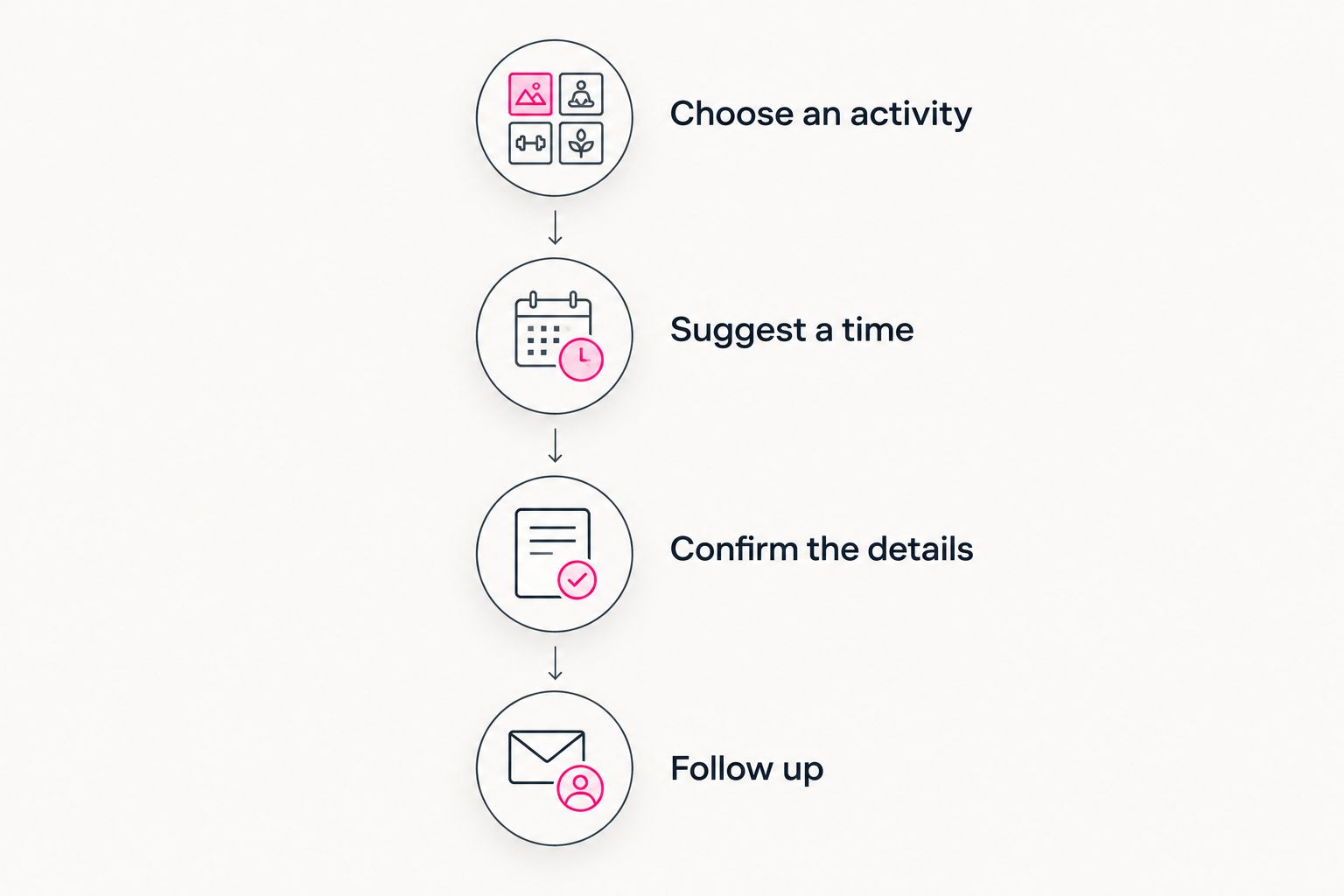
The app supplies the setting. You supply the invitation. Use this sequence to make your next step specific without pressuring someone you have just met.
Choose an activity
Pick something connected to the conversation. If you have discussed walking, suggest a public park walk rather than an unrelated evening plan. Choose a first meeting that is easy to leave independently.
Suggest a time
Offer a concrete option instead of asking whether you should hang out sometime. As a starting point, suggest a 30-minute first meetup in a public place; that is a planning recommendation, not a requirement or a claim about friendship outcomes.
Confirm the details
Agree on the meeting place and timing before leaving. Keep your home address and other sensitive information private, tell someone you trust about your plan, and arrange your own transportation.
Follow up
If you enjoyed meeting, say what you enjoyed and suggest another activity. If an invitation goes unanswered, use a personal boundary such as 2 invitations over 1 week, then stop initiating unless the other person responds. Those limits are an example you can adopt, not an app rule.
A declined invitation is not a reason to argue or ask for an explanation. Respect the answer and spend your effort on connections where interest is mutual.
How the 2026 ranking works
This ranking prioritizes the connection format, the shared context it creates, and its relationship to meeting in person. It does not rank download totals, promise friendship outcomes, or treat a platform's size as evidence that it suits your needs.
Meetup gets the overall recommendation for activity-led introductions. The other picks each serve a different starting point: nearby plans, individual introductions, ongoing hobby discussion, or existing communities. Choose by that distinction rather than reading the order as a universal quality score.
Which friendship app should you choose in 2026?
Choose Meetup if you are undecided and want a shared activity to carry the introduction. Pick a group you would enjoy attending even before you know anyone.
Choose the nearby-plan option if getting together locally is the main goal. Choose Bumble For Friends if you want individual conversation first, Discord if the hobby matters more than location, or Facebook Groups if you already have a community in mind.
Start with one format. Give yourself a concrete task—join a relevant conversation, attend an event, or propose an activity—rather than measuring progress by how many apps you install.
FAQ
What's the best app to make new friends in 2026?
Meetup is the default recommendation for people who want to meet through shared-interest events. Choose a different format if you prefer individual introductions, nearby plans, or online hobby communities.
Which friendship app focuses on nearby IRL plans?
Pulsenow focuses on helping users meet new friends and organize IRL meetups and plans with people nearby. You still need to agree on the details and decide whether a meeting feels right.
Is Meetup better than Bumble For Friends?
Meetup is the better fit for shared-interest group activities; Bumble For Friends is the better fit for individual friendship introductions. Your preferred way of meeting people determines the choice.
Can I make friends on Discord?
Discord provides ongoing communities where you can interact through shared interests. A server does not establish that members live nearby, so distinguish online friendship from finding local companions.
Are Facebook Groups useful for making local friends?
Facebook Groups offers local community discussions, but each group's purpose and rules determine whether friendship introductions belong there. Read those rules before posting or inviting members to meet.
How do I meet someone from a friendship app safely?
Choose a public place, arrange your own transportation, and tell someone you trust about the plan. Keep sensitive personal information private and leave if you feel uncomfortable.
What should I say when asking someone to hang out?
Suggest a specific activity connected to something you have already discussed, then offer a time and public meeting place. Make it easy to decline without pressure.
One last thing
Do not judge a first meetup only by whether conversation felt effortless. Ask a more useful question: Would you enjoy doing that activity with this person again? You do not need to decide whether someone is a close friend before inviting them to another walk, game, or group event.