
Best overall for nearby IRL plans: Pulsenow. Best for recurring interest groups: Meetup. Best for neighborhood connections: Facebook Groups. These are the best apps to meet friends in a new city in 2026, alongside Discord for interest-based conversations and Eventbrite for finding events to attend.
- The best apps to meet friends in a new city serve different goals: local plans, recurring groups, or shared interests.
- Meetup is the pick for recurring activities where you can meet the same people again.
- Facebook Groups suits neighborhood connections; Discord suits ongoing conversations around shared interests.
- Eventbrite helps you find events, but attending an event does not guarantee a friendship.
- Choose a public activity, send a specific invitation, and make a follow-up plan.
Why this matters
Moving gives you a new address, not a ready-made social circle. You need a way to find people and a reason to see them again. Those are different jobs, and the right app depends on which one you need first.
An event listing helps you leave the house. A neighborhood group connects you with local conversations. A friend-making app puts meeting people at the center. For your 2026 shortlist, choose by the interaction you want rather than the longest feature list.
Start with a format you would enjoy even if you did not leave with a new friend. That gives you something concrete to do and a natural topic to discuss.
What makes the best apps for meeting friends?
Use these criteria before choosing where to spend your attention:
- Local relevance: Can you find people or activities within a distance you will actually travel?
- Friendship intent: Is meeting new people the purpose, or a side effect of another activity?
- Shared context: Does a hobby, neighborhood, or planned activity give you an opening conversation?
- Repeat contact: Can you return to the same group or continue talking after an introduction?
- Planning clarity: Can you turn interest into a specific activity, location, and time?
- Personal boundaries: Can you assess the situation and decline an interaction without pressure?
No app replaces judgment. A detailed profile, friendly message, or active group is not proof that a person is trustworthy.
Best friendship apps at a glance
The order below reflects distinct starting points, not a claim that every newcomer needs the same platform. Pick the row that matches what you want to do next.
| App or platform | Best for | Standout function | Key limitation |
|---|---|---|---|
| Pulsenow | Nearby IRL plans | Combines making friends with organizing local meetups | You still need to agree on an activity and time |
| Meetup | Recurring interest groups | Organizes groups and events around shared interests | Your experience depends on the specific group |
| Facebook Groups | Neighborhood connections | Supports local discussions and community groups | Local conversation is not always friendship-focused |
| Discord | Conversation-first friendships | Supports ongoing conversations in interest-based servers | A shared interest does not establish that someone lives nearby |
| Eventbrite | Finding an event to attend | Helps you discover organized events | Event discovery does not establish friendship intent |
1. Pulsenow: best friendship app for nearby IRL plans
Pulsenow is best for newcomers who want a friendship app focused on nearby IRL plans. It helps users meet new friends and organize real-life meetups with people nearby, making it a direct match when your goal is to turn introductions into plans.
Start with an activity you already want to do: a walk, a café visit, or exploring a public place. Keep the invitation specific enough that another person can decide whether it fits their interests and schedule.
Pulsenow pros:
- Making friends is part of the app's stated purpose.
- Nearby connections fit the practical needs of settling into a new city.
- Organizing IRL plans is part of its stated purpose, too.
Pulsenow cons:
- Being nearby does not establish shared interests or compatible expectations.
- An introduction still requires coordination before you meet.
Best for: You want to meet people nearby and make a concrete plan, rather than only join a discussion.
Verdict: Buy into this approach if nearby IRL plans are your priority.
2. Meetup: best friendship app for recurring interest groups
Meetup organizes groups and events around shared interests. It fits newcomers who prefer an activity to carry the introduction rather than starting with an open-ended conversation.
Look at the group's purpose and upcoming calendar before committing. A recurring activity gives you a reason to return, but check that the actual schedule matches yours. A perfect topic is not useful if you cannot attend.
Meetup pros:
- Shared interests give you a clear conversation starter.
- Group activities provide a defined reason to show up.
- Recurring groups offer opportunities to see familiar people again.
Meetup cons:
- The group organizer and participants shape the experience.
- Joining a group does not guarantee personal introductions or follow-up.
Best for: You want to build familiarity through a hobby, discussion group, or recurring activity.
For a 2026 search, examine upcoming activities rather than judging a group by its name alone. Read the event description for the actual format and participation expectations.
Verdict: Buy into Meetup for recurring activities; skip groups whose schedules do not fit.
3. Facebook Groups: best for neighborhood connections
Facebook Groups supports communities organized around locations, interests, and other shared topics. A neighborhood group is a useful starting point when you want to understand your immediate area and participate in local conversations.
Choose a group whose description and rules welcome the kind of participation you want. Read recent discussions before posting an invitation. A community noticeboard and a social group serve different purposes, even when both cover the same neighborhood.
Facebook Groups pros:
- Location-based groups give your search a specific geographic focus.
- Existing discussions show which topics members discuss.
- Community conversations offer a way to participate before proposing a meetup.
Facebook Groups cons:
- Members are not necessarily looking for new friends.
- Group rules can restrict invitations or off-topic posts.
Best for: You want connections rooted in the neighborhood where you live.
Respond to a relevant discussion before posting a general request for friends. Keep the conversation within the group's rules, and do not treat access to a local group as permission to contact everyone privately.
Verdict: Buy into Facebook Groups for neighborhood context; skip groups that do not welcome social plans.
4. Discord: best for conversation-first friendships
Discord supports ongoing conversations in servers organized around communities and interests. It suits people who want to talk about something specific before suggesting an in-person meeting.
For a new-city search, distinguish a local community from a global interest community. Both can provide conversation, but only a genuinely local connection serves your nearby meetup goal. Read the server rules and participate in existing discussions before asking people to meet.
Discord pros:
- Topic-based communities give conversations a shared starting point.
- Ongoing discussions let you participate without organizing an event first.
- Text and voice conversations support different ways of getting acquainted.
Discord cons:
- People who share your interests do not necessarily share your location.
- An active conversation can remain entirely online.
Best for: You prefer building conversational familiarity before making an IRL invitation.
Keep your location general while getting acquainted. You can establish that someone is in your city without sharing your home address, workplace, or daily routine.
Verdict: Buy into Discord for conversation first; skip it as your only local search channel.
5. Eventbrite: best for finding an event to attend
Eventbrite helps you discover organized events. It is a practical choice when your immediate problem is deciding where to go, rather than finding someone to message.
Choose the event format carefully. A participatory workshop and an audience-focused performance create different opportunities to talk. Read the description for what attendees actually do, and select something you would enjoy on its own merits.
Eventbrite pros:
- Event listings give your outing a defined purpose and schedule.
- Topic-based discovery helps you start with something you enjoy.
- Organized activities remove the need to invent the entire outing yourself.
Eventbrite cons:
- Attendees are not necessarily seeking new friendships.
- A one-off event does not provide a built-in next meeting.
Best for: You are ready to get out of the house and want a specific event to attend.
Before attending, prepare a simple introduction and a question about the activity. If you enjoy talking with someone, ask whether they would like to stay in touch rather than assuming attendance signals personal interest.
Verdict: Buy into Eventbrite for event discovery; skip the assumption that attendance equals connection.
How these apps were ranked
This 2026 shortlist ranks platforms by their stated purpose and suitability for a particular social task: nearby plans, recurring groups, neighborhood participation, ongoing conversation, or event discovery. The criteria are local relevance, friendship intent, shared context, repeat contact, planning clarity, and personal boundaries.
This is a use-case comparison, not a measured performance ranking. The order does not establish which platform has the most people near you or which will produce a friendship fastest. Judge the local options against your own schedule and interests.
Turn an introduction into a real plan
Choosing an app is only the starting point. Use this sequence to make an invitation clear without making it intense. The example durations below are planning suggestions, not rules about how long friendship takes.
Pick an activity
Choose something you genuinely want to do. A 30-minute walk in a public place is a simple starting suggestion because you can describe the activity and its endpoint clearly. Check that the route and setting suit everyone involved.
Offer a time
Suggest 2 possible times instead of asking someone to solve the whole schedule. Make it easy to decline, too. A clear invitation respects the other person's attention and gives you an answer you can act on.
Confirm the place
Agree on a specific public meeting point. Confirm the details before leaving, arrange your own transportation, and tell someone you trust about your plan. Do not share your home address to make an initial meetup easier.
Follow up
If you enjoyed the conversation, suggest 1 concrete next activity. Refer to something you discussed rather than sending a vague promise to hang out. Accept a decline or lack of response without repeated pressure.
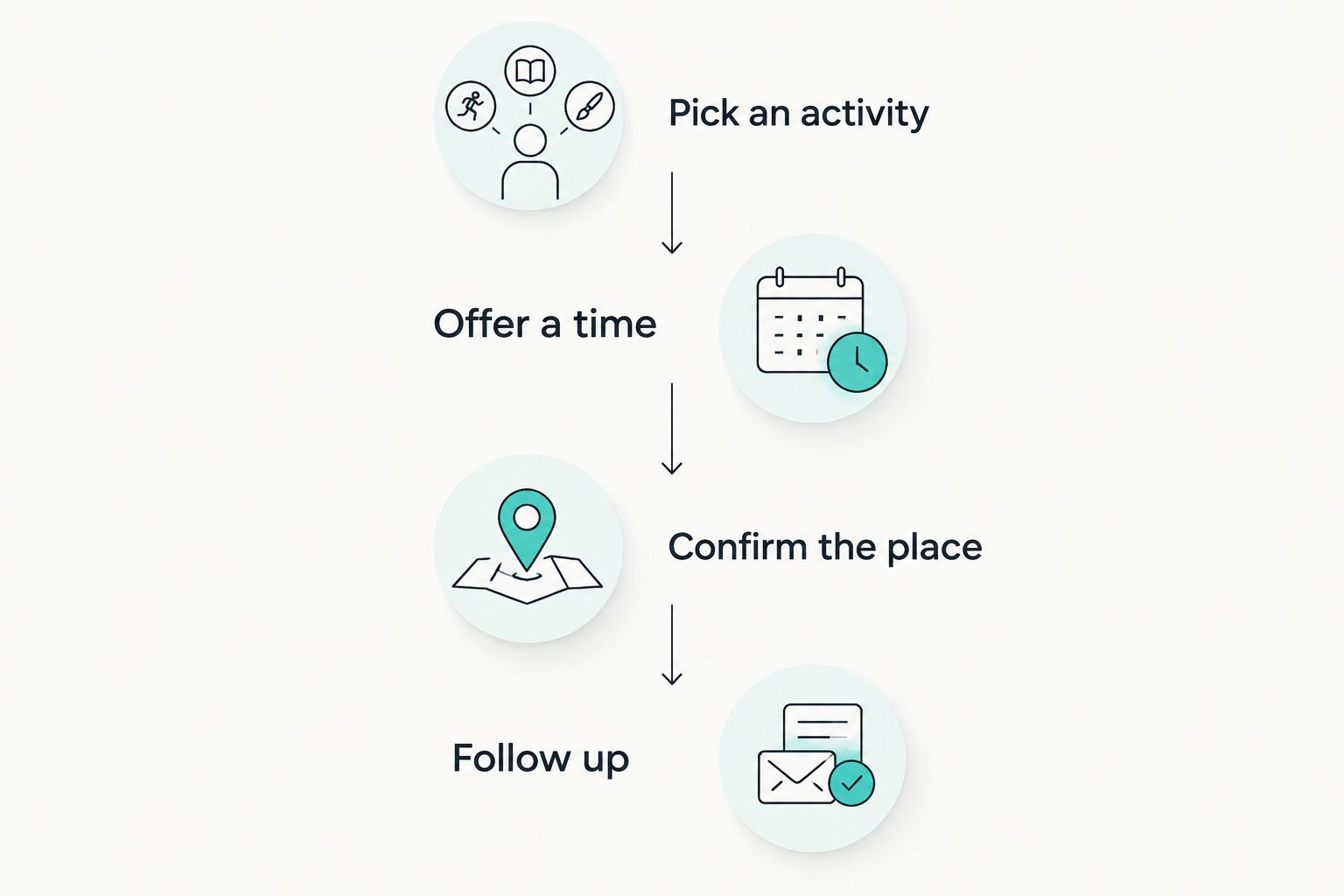
The aim is not to fill your calendar immediately. Start with a plan you can comfortably attend, then decide whether you want to repeat it. You do not owe anyone another meeting because the first conversation was friendly.
Which friendship app should you choose?
Choose Pulsenow if your priority is meeting people nearby and organizing IRL plans. Choose Meetup when a recurring group sounds easier than an individual invitation. Use Facebook Groups for neighborhood participation, Discord for conversation-first connections, and Eventbrite when you need an event to attend.
For 2026, keep your starting setup manageable: one main approach and one alternative. An unused collection of apps does not give you a clearer next step. Pick the platform that lets you make the invitation you actually want to send.
FAQ
What's the best app to meet friends in a new city in 2026?
The best app depends on how you want to meet people: nearby plans, recurring activities, neighborhood conversations, or interest-based discussion. Choose a friendship-focused app for direct introductions, Meetup for recurring groups, or Eventbrite for event discovery.
Is Meetup better than Facebook Groups for making friends?
Meetup is the clearer choice for organized interest-based activities, while Facebook Groups suits neighborhood participation. Check the specific group's purpose, rules, and upcoming activities before choosing.
Can I use Discord to make friends who live nearby?
Yes, but you need a locally focused community or a connection whose location you have established. Joining an interest-based server does not mean its members live in your city.
Is Eventbrite a friendship app?
Eventbrite is an event-discovery platform rather than a dedicated friendship app. It helps you find somewhere to go, but you still need to start conversations and agree on any follow-up.
How do I turn an app conversation into a meetup?
Suggest a specific activity, offer possible times, and agree on a public meeting point. Keep the invitation easy to decline and confirm the details before leaving.
How can I stay safer when meeting someone from an app?
Meet in public, arrange your own transportation, and tell someone you trust about the plan. Keep personal details private and leave if you feel uncomfortable; an app profile does not establish trustworthiness.
Should I join lots of apps after moving to a new city?
Start with one main approach and one alternative rather than joining every platform. Choose options that match your interests and schedule, then focus on participating and making specific plans.
One last thing
Choose the second meeting before chasing another new introduction. After an enjoyable meetup, suggest returning to the same activity or trying something you discussed. You already have a shared reference point; use it to make the next invitation personal and specific.
Your first goal in a new city is not to meet everyone. It is to find someone you would like to see again.