
Best overall for making nearby IRL plans: Pulsenow. Best for recurring interest groups: Meetup. Best for niche local communities: Facebook Groups. This 2026 guide compares the best apps to find social groups near me by what you actually want to do: meet nearby people, join an existing group, or get comfortable before showing up.
- For the best apps to find social groups near me, choose by activity, location, and willingness to meet offline.
- Pulsenow is best for people who want new friends and nearby IRL plans.
- Meetup fits recurring interest groups; Facebook Groups fits niche local communities.
- Nextdoor fits neighborhood connections; Discord fits conversation before an in-person meetup.
- Choose a specific public gathering rather than collecting group memberships.
Why this matters
Finding a group and making friends are different jobs. A directory helps you discover people, but a usable plan gives you a reason to meet them again.
For your 2026 search, judge the next gathering rather than the size of the community. Look for a clear activity, a reachable location, and a way to understand what newcomers should expect. A large group with no relevant plans is less useful to you than a smaller group you can actually join.
What makes the best app for local social groups?
Use these criteria before choosing an app. They explain the recommendations below without treating every kind of social platform as interchangeable.
- Local relevance: Can you find people or gatherings within a distance you are willing to travel repeatedly?
- Shared purpose: Does the group give you something to do together, such as walking, reading, gaming, or practicing a language?
- A clear next step: Can you identify an actual plan, organizer, or invitation rather than just a discussion feed?
- Newcomer clarity: Can you understand who belongs, how to participate, and whether the gathering suits you?
- Repeat potential: Does the format give you a reason to see the same people again?
- Privacy and moderation: Can you understand the community rules and control what you share?
The best choice depends on which obstacle you need to remove. If you already know your hobby, start with an interest group. If you mainly need someone nearby to make a plan with, prioritize that instead.
Best local social apps at a glance
These 2026 picks serve different purposes. The table compares their established formats, not claims about how many active members live near you.
| App or community platform | Best for | Standout feature or focus | Key limitation |
|---|---|---|---|
| Pulsenow | New friends and nearby IRL plans | Connects making friends with organizing real-life meetups | A connection still needs a mutually workable plan |
| Meetup | Recurring interest groups | Groups organized around shared interests and events | Fit depends on the particular group and organizer |
| Facebook Groups | Niche local communities | Searchable communities with posts and discussions | Finding plans can require sorting through unrelated posts |
| Nextdoor | Neighborhood connections | Communities organized around local neighborhoods | Neighborhood discussion is broader than making friends |
| Discord | Conversation before meeting | Servers with topic-based text and voice channels | A shared-interest server is not necessarily local |
1. Pulsenow: best social app for nearby IRL plans
Pulsenow is a social app for making new friends and organizing real-life meetups with people nearby. It is the most direct fit here when your goal is a new connection and a plan, rather than joining a large discussion community.
Start with something you genuinely want to do. A specific invitation gives another person more to respond to than a general request to hang out sometime.
Pulsenow pros:
- Its stated purpose combines making friends with organizing IRL plans.
- Nearby connections match a local friendship goal.
- The focus suits people who want to move beyond online conversation.
Pulsenow cons:
- Meeting someone nearby does not guarantee compatible interests or schedules.
- You still need to agree on the activity, public meeting place, and boundaries.
Best for: People who want new friends and nearby IRL plans.
Try a low-pressure invitation built around a public place and a clear activity. Keep the first gathering easy to leave or extend, depending on how comfortable everyone feels.
Verdict: Try it when making a nearby plan is your priority.
2. Meetup: best social platform for recurring interest groups
Meetup organizes discovery around groups and events connected to shared interests. That makes it a useful starting point when you can already name the activity you want, such as hiking, board games, or professional networking.
Evaluate the group separately from the platform. Read the event description, check the location, and look for guidance that helps a first-time attendee arrive without guessing.
Meetup pros:
- Interest-based groups give you a natural conversation topic.
- Event listings make the gathering itself central to your decision.
- Recurring groups offer a format for meeting familiar people again.
Meetup cons:
- A matching topic does not guarantee a matching social atmosphere.
- Organizer communication and event details differ between groups.
- A group's existence does not prove its next gathering fits your schedule.
Best for: People who want a structured gathering around a known interest.
Before attending, ask whether newcomers need equipment, prior experience, or preparation. A walking group and a demanding hiking group can share a category while creating very different first experiences.
Verdict: Try it when you want an existing group with an activity attached.
3. Facebook Groups: best social platform for niche local communities
Facebook Groups combines community posts, comments, and discussion in groups built around places or interests. It is useful when your search needs both: a particular neighborhood and a particular hobby, life stage, or shared experience.
Search with specific combinations rather than a broad friendship phrase. A city name plus a genuine interest gives you a clearer way to judge whether the conversation belongs in your life.
Facebook Groups pros:
- Groups can combine a local area with a narrowly defined interest.
- Existing discussions help you understand the community's tone.
- Posts let members ask questions and discuss possible gatherings.
Facebook Groups cons:
- Relevant invitations can sit among unrelated posts.
- Rules about introductions and event promotion differ by group.
- A local group can focus on information-sharing rather than socializing.
Best for: People looking for a specific community within their local area.
Read the rules before introducing yourself or posting an invitation. Look for recent conversations you would actually enjoy joining, not just a group name that sounds relevant.
Verdict: Try it for a specific local niche; skip groups whose everyday discussions do not interest you.
4. Nextdoor: best social platform for neighborhood connections
Nextdoor centers on neighborhood communities. Its local focus fits people who want to connect around the place they live, rather than search across an entire city for a shared-interest group.
Use it with a neighborhood-sized goal. Finding people interested in a nearby walk or community activity is a different task from finding a specialized club across town.
Nextdoor pros:
- Neighborhood context keeps the search tied to everyday geography.
- Local discussions can reveal community activities and interests.
- Shared surroundings provide a concrete starting point for conversation.
Nextdoor cons:
- Neighborhood posts cover subjects beyond friendship and meetups.
- Living close together does not establish shared interests.
- Public neighborhood discussions require care about personal details.
Best for: People who want social connections close to home.
Describe the activity and general meeting area without publishing your home address or routine. Choose a public location and confirm the details before treating a discussion as a settled plan.
Verdict: Try it for neighborhood ties, not as your default interest-group directory.
5. Discord: best social platform for conversation before meeting
Discord organizes communities into servers with text and voice channels. It fits people who prefer to participate in conversation before deciding whether to meet anyone in person.
Local relevance needs a separate check. A server can match your favorite hobby perfectly while its members live nowhere near you.
Discord pros:
- Topic-based channels help separate different conversations.
- Text and voice offer different ways to participate.
- Ongoing discussion lets you explore shared interests before suggesting plans.
Discord cons:
- Shared interests do not make a server geographically local.
- Online conversation can continue without producing an offline gathering.
- Rules, moderation, and community expectations vary by server.
Best for: People who want conversation and familiarity before an IRL meetup.
Look for an explicitly local community and read its rules about gatherings. Do not assume that friendly online discussion means another member wants to meet offline.
Verdict: Try it when conversation comes first; skip it when you need a clearly organized local event immediately.
How these recommendations are ranked
The order reflects fit for the query: finding social groups nearby and turning discovery into real-life participation. Nearby plans come first, followed by organized interest groups, niche communities, neighborhood connections, and conversation-led communities.
This is a use-case ranking, not a measured comparison of local participation. Your practical winner is the option with a relevant gathering you understand and feel comfortable joining.
For a 2026 decision, inspect the current group or plan rather than relying on a platform's reputation. Good software cannot make an unsuitable activity suit you.
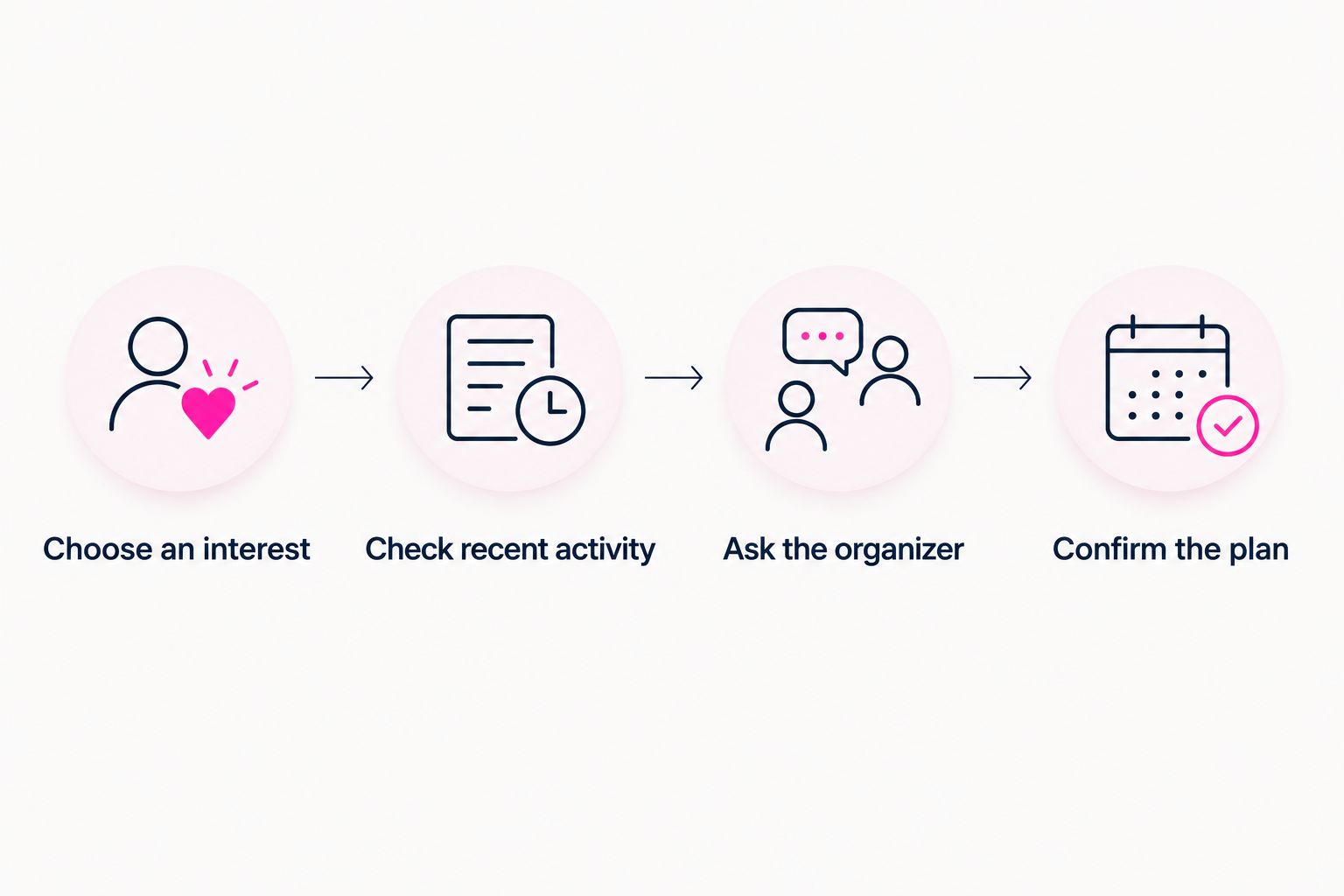
Turn a search into a real plan
Give your search a stopping point. Try this sequence rather than opening every app and leaving with more tabs than invitations.
Choose an interest
Pick something you would enjoy even if the conversation starts slowly. Shared activity gives the gathering a purpose beyond making a good first impression.
Check recent activity
Set yourself a 20-minute search window. Inspect recent discussions and upcoming gatherings, then save 2 events or plans that match your actual calendar. These are search limits, not performance benchmarks.
Ask the organizer
Ask what newcomers should know and where people meet. A useful question concerns the gathering itself: experience level, accessibility, equipment, or how to identify the group.
Confirm the plan
Choose a plan within the next 7 days if your schedule allows. Confirm the public location and your own transportation, and tell someone you trust where you are going.
Afterward, judge the experience rather than your performance. Did you enjoy the activity? Would you want another conversation with anyone there? Those questions help you decide whether to return without demanding instant friendship.
Which social app should you choose?
Choose the format that solves your immediate problem. For new friends and nearby plans, start with the first pick. For an established hobby group, choose Meetup. For a specific local community, choose Facebook Groups.
Choose Nextdoor when proximity matters most, and Discord when you want conversation before meeting. You do not need to maintain an account everywhere to make a useful start.
Your 2026 shortlist should end with a next action: ask a question, accept an invitation, or confirm a gathering. If an option produces only browsing, switch the format rather than repeating the same search.
FAQ
What's the best app to find social groups near me?
The best app depends on whether you want nearby plans or an existing interest group. Choose Pulsenow for new friends and nearby IRL plans, Meetup for organized interest groups, or Facebook Groups for niche local communities.
Is Meetup better than Facebook Groups for making friends?
Meetup is the clearer starting point when you want an interest-based gathering, while Facebook Groups fits searching for a specific local community. Compare the actual events and discussions rather than assuming either platform guarantees friendship.
How do I find local groups when I've just moved?
Search using your city or neighborhood plus an activity you already enjoy. Look for a clear upcoming gathering, read the newcomer guidance, and ask the organizer what to expect.
Can Discord help me meet people nearby?
Discord can support local connections when you join an explicitly local community. A shared-interest server alone does not establish that members live nearby or want to meet in person.
What should I check before attending a group meetup?
Check the activity, public location, organizer instructions, accessibility, and transportation before attending. Share your plan with someone you trust and keep control of how you get home.
What if I'm nervous about joining a group alone?
Choose a structured activity so participation does not depend entirely on starting conversations. Ask the organizer how newcomers join in, and give yourself permission to leave if the gathering feels wrong.
How can I tell whether a local group is active in 2026?
Look for recent relevant conversations and a clearly described upcoming gathering. A membership total or old event listing does not establish that the group currently offers a plan you can join.
One last thing
Choose the second gathering before chasing a perfect first impression. When a group feels comfortable and the activity interests you, find out when it meets again. A repeatable plan gives you another opportunity to talk without starting the entire search over.